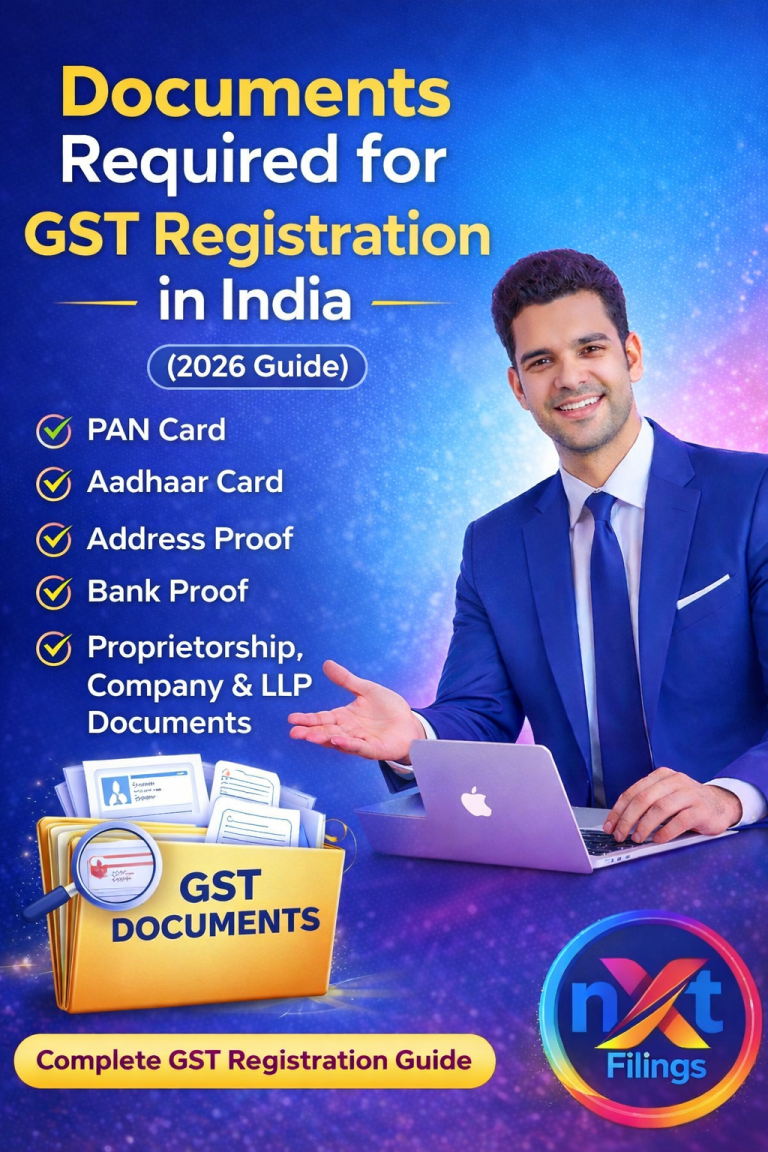


Starting a business in India requires compliance with several tax regulations. One of the most important registrations for businesses is GST Registration.
The Goods and Services Tax (GST) is a unified indirect tax system implemented across India. Businesses that meet certain criteria must obtain GST registration to legally collect tax and file GST returns.
In this guide, we will explain:
- What GST Registration is
- Who needs GST Registration
- Documents required for GST Registration
- GST Registration process step by step
- GST registration fees and timeline
If you want professional assistance, NxtFilings by Laraware, founded by fintech entrepreneur Anvesh Tiwari, provides expert GST registration services across India.
What is GST Registration
GST Registration is the process through which a business registers under the Goods and Services Tax system and receives a GSTIN (Goods and Services Tax Identification Number).
GSTIN is a 15-digit unique identification number assigned to each registered taxpayer.
Once registered, businesses can:
- Collect GST from customers
- File GST returns
- Claim input tax credit
- Operate legally across India
Who Needs GST Registration in India
GST registration becomes mandatory in several cases.
1. Business Turnover Threshold
Businesses must register if annual turnover exceeds:
- ₹40 lakh for goods businesses
- ₹20 lakh for service businesses
2. E-commerce Sellers
Businesses selling on platforms like Amazon, Flipkart, and Meesho must obtain GST registration regardless of turnover.
3. Inter-State Supply
If goods or services are supplied across state borders, GST registration is required irrespective of turnover.
4. Input Tax Credit Benefits
Businesses wanting to claim input tax credit (ITC) on their purchases must register for GST.
Documents Required for GST Registration
Businesses need several documents for GST registration depending on the type of business entity.
For Proprietorship
- PAN card of the proprietor
- Aadhaar card
- Passport-size photograph
- Bank account details (cancelled cheque or passbook)
- Address proof of business premises
For Private Limited Company / LLP
- Company PAN card
- Certificate of Incorporation
- MOA & AOA (for company) / LLP Agreement
- Director/Partner PAN and Aadhaar
- Business address proof (rent agreement + NOC or electricity bill)
You can also read our detailed guide: Documents Required for GST Registration
GST Registration Process – Step by Step
GST registration is completed online through the official GST portal. Here is the step-by-step process:
Step 1 – Visit GST Portal
Go to the official GST website: www.gst.gov.in
Step 2 – Select New Registration
Navigate to: Services → Registration → New Registration
Step 3 – Fill Basic Details
Enter the following information:
- PAN number
- Email address
- Mobile number
- State of registration
You will receive an OTP on both email and mobile for verification.
Step 4 – Complete Application Form
Fill detailed business information including:
- Business name and trade name
- Business address with proof
- Promoters / Directors details
- Bank account details
- Nature of business activity
Step 5 – Upload Documents
Upload all required documents including identity proof, address proof, and business registration documents.
Step 6 – Submit Application
Submit the application using one of the following methods:
- OTP verification (for proprietorship)
- Digital Signature Certificate (DSC) (for companies and LLPs)
Step 7 – GSTIN Issued
Once the application is verified and approved by the GST officer, your GSTIN and GST Registration Certificate will be issued. You can download the certificate from the GST portal.
GST Registration Fees
The government does not charge any fee for GST registration. The entire process is free on the GST portal.
However, if you use professional service providers like NxtFilings for handling the application process, a nominal service fee may apply for expert assistance.
Read more: GST Registration Fees in India – Complete Details
GST Registration Timeline
Typically, GST registration approval takes:
3 – 7 working days from the date of application submission, provided all documents are correct and complete.
If the GST officer raises a query or requests additional documents, the timeline may extend. Responding promptly to any clarification requests is important.
Benefits of GST Registration
Legal Business Recognition
GST registration gives your business official tax recognition under the Indian tax system. It adds credibility and enables you to issue GST-compliant invoices.
Input Tax Credit
Registered businesses can claim GST paid on purchases and business expenses as Input Tax Credit (ITC), reducing overall tax liability.
E-commerce Selling
Online marketplaces like Amazon, Flipkart, and Meesho require sellers to have a valid GST registration before listing products.
Seamless Interstate Business
GST registration enables seamless interstate business operations without the need for multiple state-level tax registrations.
How NxtFilings Helps Businesses
NxtFilings, part of the Laraware fintech ecosystem, provides complete compliance services including:
Founded by Anvesh Tiwari, Laraware has been featured in major media outlets including Forbes India for its AI-powered fintech innovation.
Our experts ensure fast and hassle-free GST registration for businesses across India.
Frequently Asked Questions (FAQ)
What is the turnover limit for GST registration?
For goods businesses, the limit is ₹40 lakh annual turnover. For service businesses, it is ₹20 lakh. For special category states, the limit is ₹10 lakh.
Is GST registration free?
Yes, the government does not charge any fee for GST registration. You can apply for free on the GST portal at gst.gov.in.
How long does GST registration take?
GST registration typically takes 3 to 7 working days if all documents are submitted correctly.
Can I register for GST voluntarily?
Yes, any business can register for GST voluntarily even if their turnover is below the threshold limit. This is useful for claiming input tax credit.
What is GSTIN?
GSTIN is a 15-digit Goods and Services Tax Identification Number assigned to every registered taxpayer. It is unique to each state-level registration.
Conclusion
GST registration is an essential compliance requirement for many businesses in India. Understanding the registration process, eligibility criteria, and required documentation can help ensure smooth approval and avoid delays.
Businesses can seek expert assistance from professional service providers like NxtFilings for faster and more reliable GST registration.
Ready to register for GST? Get started with NxtFilings today →

Need Help with GST?
Our experts can handle your compliance needs. Get started in minutes.